A quiet breath with Plumble
An activity to try together, right here. Joining in is optional.
 Plumble’sworld™
A calm down corner is a small, soft spot a child can go to when everything gets too big. It is not a time out. It is somewhere to land.
 A printable to try together ↗
Print these two tools for a cozy space at home or preschool. Use them together with a grown-up. No email or signup required.
Open an image, save it, then print using “Fit to page.” Find the free feelings chart and all six preschool printables.
A time out is something you send a child to. A calm down corner is somewhere they choose to go, and you are welcome to go with them. If it is used as a punishment even once, most little ones will refuse it afterwards, so it is worth protecting from the start.
That is the whole list. Corners that get crowded stop being calm, and a basket of ten fidget toys turns into a toy bin by the second week.
Somewhere you can see. A toddler who is upset does not want to be alone, they want the noise to stop. A corner of the living room works better than a bedroom at the end of a hall.
In a classroom, put it out of the main traffic path but inside the teacher’s line of sight, and make it big enough for a child and one grown-up.
Never introduce it mid-meltdown. Set it up on a calm afternoon and let your child choose the cushion.
“I am feeling frustrated. I am going to sit in the corner for a minute.” That single move teaches more than any explanation.
“Do you want to go to the soft corner, or do you want me to come with you?” Both answers are fine.
Silence next to a child is doing something. Fill it later, not now.
“You were really angry, and now you are quieter.” That is the whole lesson, in one sentence, at the right moment.
Two common reasons. Either it has been used as a punishment at some point, or it is too far away from where the family actually is. Move it closer before you give up on it.
Plumble’s World is a calm, gentle media experience for children ages 2 to 5, designed to create opportunities for connection and conversation. It is not a therapeutic or clinical program. If big feelings are getting harder over months rather than easier, speak with your pediatrician or your child’s teacher.
An activity to try together, right here. Joining in is optional.
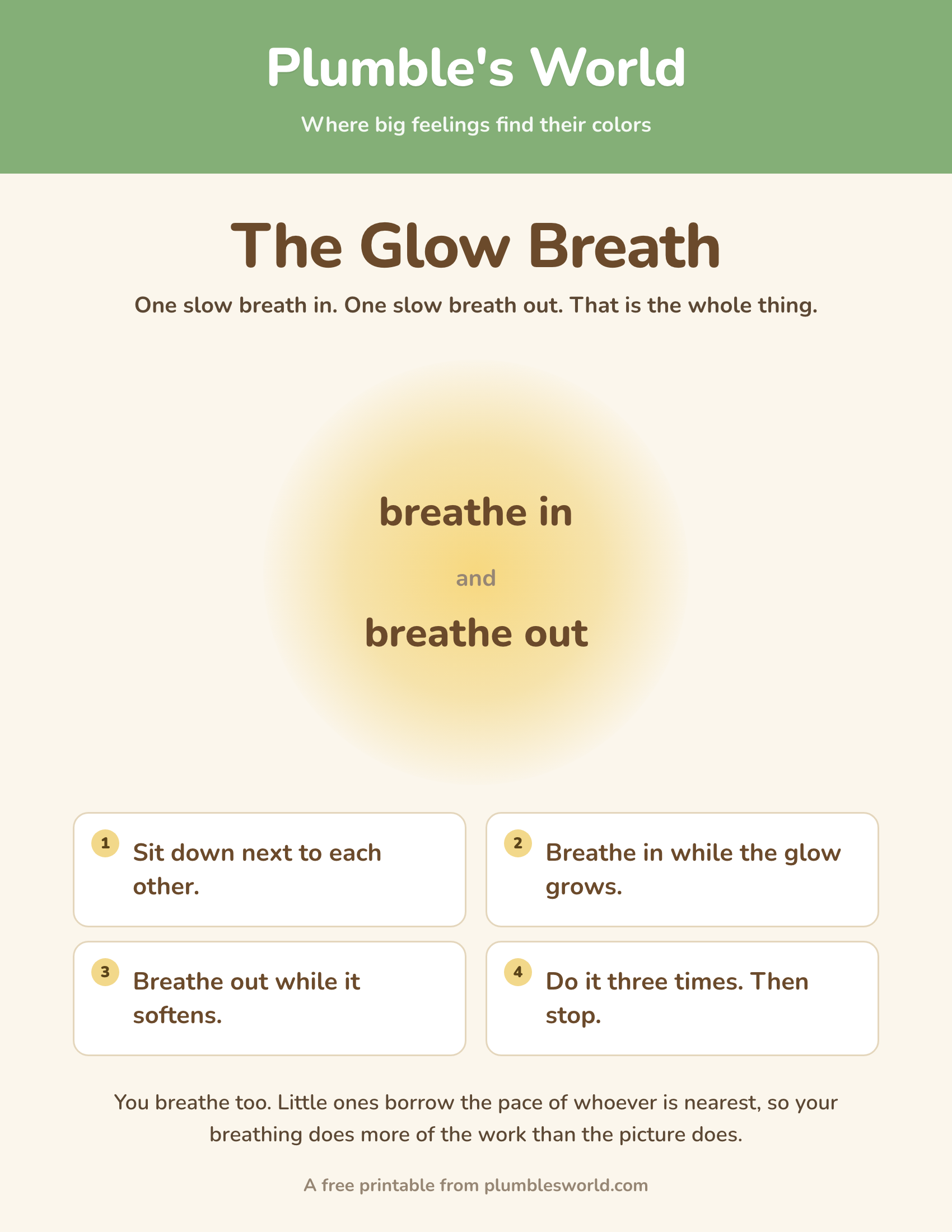
The Glow Breath is one slow breath in and one slow breath out, and that is the whole thing. Short on purpose, because a long video is no use in the middle of a hard moment.
Play it in the corner and breathe along yourself. Little ones borrow the pace of whoever is nearest, so your breathing does more of the work than the screen does.
For when there is more time, or the corner is being used to wind down rather than cool off.
Noticing one small thing at a time. Lovely after a busy day.
A breathing song to breathe along with, slow the whole way through.
The free Big Feelings Chart was made for exactly this spot. Nine feeling words, nine soft colors, low on the wall where a child can reach it.
If the corner is mostly getting used at the end of the day, the bedtime songs suit it better, and the full song list has the rest. There is more on the moment itself in helping a toddler with big feelings.
Nine feeling words and nine soft colors, ready to print at home. Made for grown-ups to use with children ages 2 to 5, at home or in a classroom.
Everything new lands on the YouTube channel first, including the animated episodes when they arrive.