
In this article
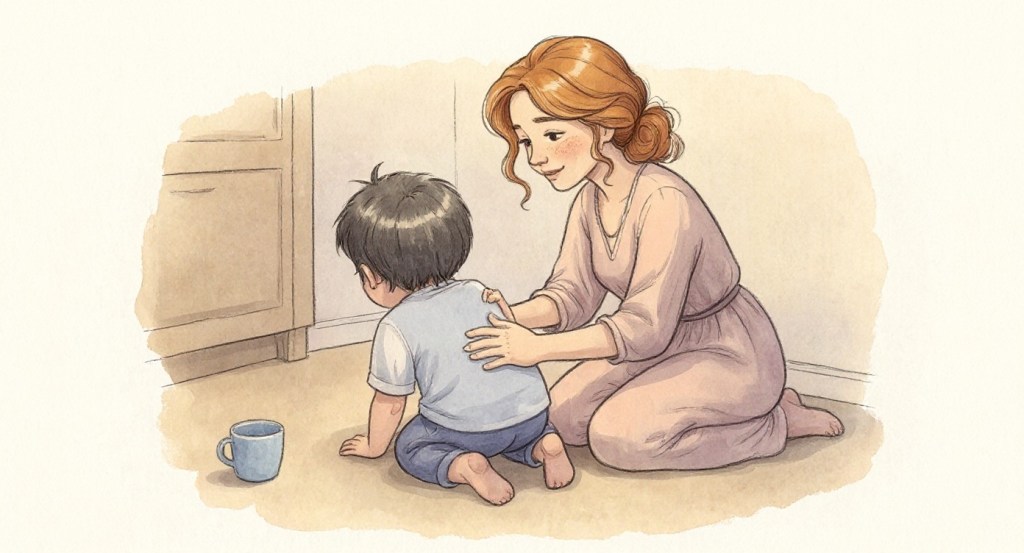
A toddler melts down and you need to respond while managing your own feelings. It can help to decide in advance what you might say.
So it’s worth deciding in advance what you want it to be.
What usually comes out
Four things, mostly, and none of them is a parenting failure. They’re just what a tired adult reaches for.
- The explanation. “We can’t have the blue cup; it’s in the dishwasher.”
- The distraction. “Look, a dog!”
- The minimizer. “You’re fine. It’s only a cup.”
- The stop. “That’s enough now.”
They all have the same shape underneath. Each one is trying to get the feeling to end. A distressed three-year-old may need help settling before an explanation is useful. We cannot know exactly what a child hears in each moment.
What the research is actually about
There’s a decent body of work here, and it’s more specific than “validate their feelings,” which, by now, has been said so often that it no longer means anything.
It starts with a simple observation. Parents differ in how they feel about their own children’s negative emotions. Some treat a child’s sadness or anger as a moment worth stepping into. Others treat it as something to be tidied away quickly. Gottman and colleagues called this a parent’s meta-emotion philosophy and found the two groups behaved differently in the moment, in ways their children’s later functioning tracked (Gottman et al., 1996). A review two decades on found the basic pattern had held up across a fair range of studies (Katz et al., 2012).
The study I’d point at first
The one worth knowing is an actual trial on this actual age group. Researchers in Australia randomly assigned 216 parents of children aged 4 and 5 to a short group program called Tuning in to Kids or to a waitlist. The six-session program, plus two booster sessions, taught parents to recognize and respond to children’s emotions and to manage their own reactions.
Six months on, parents in the program group were dismissing their children’s emotions less and were more aware of their own. That part could be self-flattery, so the useful detail is that it also showed up in observed parent-child interaction: those parents were watched using more emotion labels and talking more about what causes feelings. Their children’s emotional knowledge improved, and child behavior problems decreased (Havighurst et al., 2010).
Notice what was taught. Not a technique for calming a child down. A change in what the adult does first.
Saying the feeling out loud
The specific move of putting a name on a feeling has its own literature, usually called affect labeling. Across a run of studies, describing an emotion in words tends to take some heat out of it, even though people generally expect it to do nothing or to make things worse (Torre & Lieberman, 2018).
I have to be straight about the limit here. Much of that work is on adults labeling their own feelings. A grown-up naming a preschooler’s feeling for them is related to, not the same as, that, and I couldn’t find any work that establishes the transfer. Treat it as a reasonable bet with a good rationale behind it rather than a demonstrated effect in children.
The developmental case for it is separate and older. Regulating strong feelings is a skill that develops gradually across the preschool years, and early on, a child leans on an adult to do part of the work (Kopp, 1989). Supplying the word is one small part an adult can do.
A sentence to have ready
A short phrase prepared in advance can be easier to remember when the moment is stressful.
The shape that follows the research is: name it, then stay.
- “You really wanted the blue one.”
- “That’s disappointing. I’m here.”
- “You’re so cross. I’m going to sit down next to you.”
Then nothing. No “but”, no “so what we’re going to do is”. Try giving the feeling room before explaining the limit. This exact wording has not been tested as an intervention.
You can keep the limit and explain it after you have acknowledged the feeling.
If they can’t hear you
Sometimes a child is past the point of taking in words at all. Naming the feeling to a child who’s screaming into the carpet isn’t going to land, and repeating it louder makes it worse.
That’s fine. The sentence isn’t a spell that has to be cast at the right second. Sit nearby, stay quiet, keep everyone safe, and say it when they surface. Most of what you’re providing at the peak is company.
Afterward is a real opportunity, and it gets overlooked. A calm child can talk about a feeling they had twenty minutes ago far better than they could talk about one they were having. “You got so cross about the cup earlier” is a much easier conversation, and it’s the one where the word actually attaches to the thing.
Giving them the words in advance
A child can’t use a word they’ve never been handed, and the middle of a meltdown is a poor time to introduce one. Most of this work happens on ordinary afternoons.
That’s most of what Plumble is doing. Her glow changes color before she has found the word for what’s happening, which is roughly where a four year old lives. There’s a free Big Feelings Chart with nine feeling words on it if you want them somewhere a child can point at them, and no email to hand over for it. Our page on helping a toddler with big feelings covers the same ground in shorter form.
Where the evidence runs out
Four things to weigh before you take any of this as settled.
- The parents in the Tuning in to Kids trial knew which group they were in, which inflates anything they reported about themselves. The observed interaction and the child measures are harder to explain away, but the design can’t rule out the possibility that parents were performing for the researchers.
- The meta-emotion work is largely correlational. Parents who step toward their children’s feelings differ from parents who don’t in many other ways too.
- The affect labeling research is on adults, as above.
- Everything here is about typical development. It isn’t a treatment for anything.
The specific sentences above are ours. They follow from the work. They haven’t been tested as sentences.
When it doesn’t work
Plenty of the time it won’t, and that isn’t the measure. A hungry, overtired child at half past five is going to melt down whatever sentence you use. You’re not trying to prevent the feeling. You’re trying to be a particular way while it happens, and you get to do that badly some days.
If the meltdowns are very frequent, very long, involve real injury to your child or someone else, or aren’t easing as your child gets older, that’s worth raising with your pediatrician rather than working it out alone.
Sources
We’d rather show our working than sound certain.
- Gottman, J. M., Katz, L. F., & Hooven, C. (1996). Parental meta-emotion philosophy and the emotional life of families: Theoretical models and preliminary data. Journal of Family Psychology, 10(3), 243–268. https://doi.org/10.1037/0893-3200.10.3.243
- Havighurst, S. S., Wilson, K. R., Harley, A. E., Prior, M. R., & Kehoe, C. (2010). Tuning in to Kids: Improving emotion socialization practices in parents of preschool children. Journal of Child Psychology and Psychiatry, 51(12), 1342–1350. https://doi.org/10.1111/j.1469-7610.2010.02303.x
- Katz, L. F., Maliken, A. C., & Stettler, N. M. (2012). Parental meta-emotion philosophy: A review of research and theoretical framework. Child Development Perspectives, 6(4), 417–422. https://doi.org/10.1111/j.1750-8606.2012.00244.x
- Kopp, C. B. (1989). Regulation of distress and negative emotions: A developmental view. Developmental Psychology, 25(3), 343–354. https://doi.org/10.1037/0012-1649.25.3.343
- Torre, J. B., & Lieberman, M. D. (2018). Putting feelings into words: Affect labeling as implicit emotion regulation. Emotion Review, 10(2), 116–124. https://doi.org/10.1177/1754073917742706
Plumble’s World is a calm, gentle media experience for children ages 2 to 5. It is not a therapeutic or clinical program, and it is not a substitute for advice from your pediatrician.